
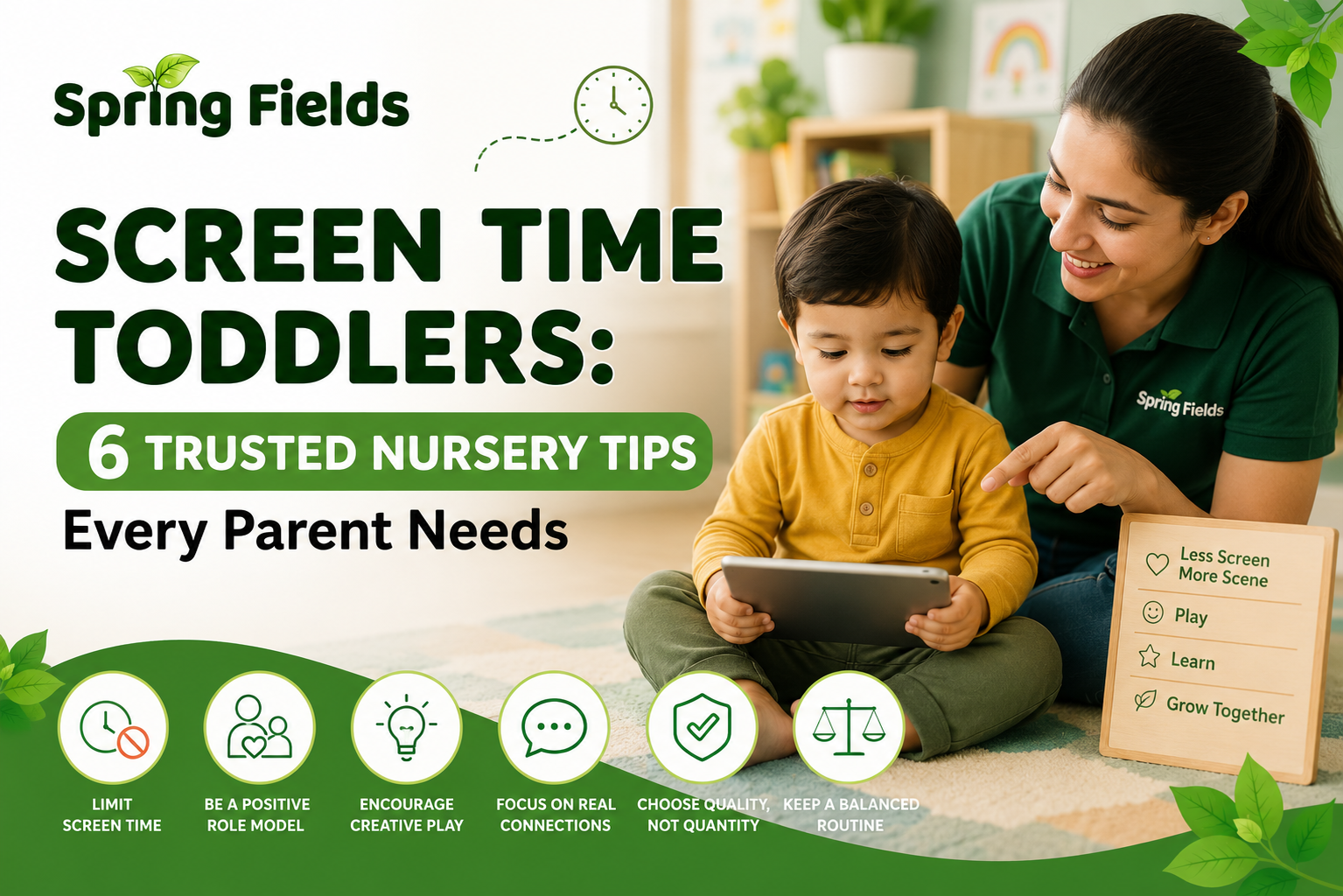
Screen Time Toddlers: 6 Trusted Nursery Tips Every Parent Needs
Screen time and toddlers is one of the most reliably heated topics in any parent group in Abu Dhabi. Every parent has an opinion. Most parents have some guilt. And almost everyone feels uncertain about where the line actually is.
The question of how much screen time is too much for toddlers is important, and nursery professionals who work with young children every day have a perspective on this that is worth hearing. Not because they are anti-technology, but because they see every day what happens to children’s attention, social skills, and creative capacity when screens dominate their early years.
Here are six trusted, nursery-backed pieces of advice on managing screen time for toddlers.
What the Research Says About Screen Time and Toddlers at Nursery Age
Before the specific tips, it is worth anchoring the conversation in evidence. The World Health Organisation’s 2019 guidelines on screen time for toddlers recommend no screen time at all for children under two years old other than video chatting, and a maximum of one hour per day of high-quality programming for children aged two to four.
According to WHO’s guidelines on physical activity and sedentary behaviour for children under five, sedentary screen time specifically should be as limited as possible, with the emphasis on physical play, interaction, and sleep as the foundations of healthy development.
These are not the guidelines of a fringe movement. They represent the consensus of the world’s most respected health organisation, and they are significantly more restrictive than the screen habits of most modern families.
Tip 1: Understand Why Screen Time Affects Toddlers Differently Than Older Children
Screen time advice for toddlers is different from advice for older children or adults for an important reason. The toddler brain is in a uniquely sensitive period of development, and screens interact with that developing brain in specific ways.
Young children learn through interaction, through feedback loops where they do something and see an immediate result, through the physical and sensory engagement of real-world play. Screens displace this kind of learning without replacing it. A toddler watching a show about colours is not learning about colours in the way that a toddler mixing paints is learning about colours.
Nursery teachers who observe children daily notice the difference between children who have had substantial screen time before nursery and those who have not. Children with high screen time often show shorter attention spans for activities that do not provide constant stimulation, reduced tolerance for the slow pace of real-world exploration, and sometimes less developed imaginative play skills.
This is not about guilt. It is about understanding what the developing brain actually needs, which is interaction, movement, conversation, and sensory experience.
Tip 2: Replace Screen Time With the Same Things Nursery Offers
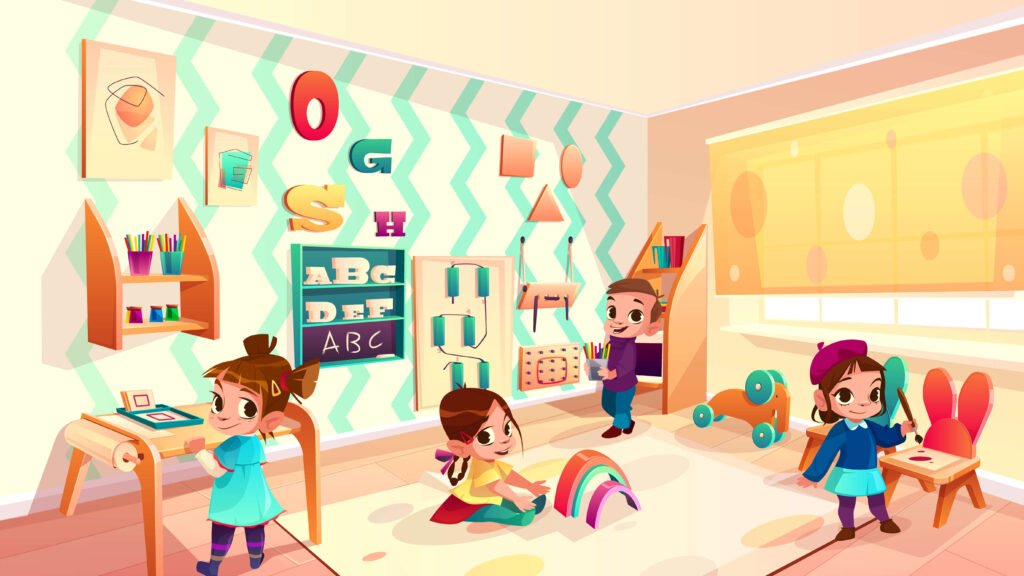
One of the most practical pieces of screen time advice from nursery professionals for toddlers is to look at what nurseries do during the day and replicate elements of it at home.
Nurseries are not interesting to children because they have expensive toys or special technology. They are interesting because they offer variety, novelty, peer interaction, physical movement, and adult engagement that is focused on the child. Most of these things can be created at home without any equipment at all.
A box of old kitchen utensils to play with on the floor. A bowl of dried pasta to sort and pour. A pile of cushions to build a fort with. A bucket of water and some cups in the garden. These are the kinds of activities that hold a two year old’s attention better than a screen, once they have become accustomed to not defaulting to one.
Tip 3: Be Honest About Your Own Screen Habits Around Toddlers
One of the most consistently overlooked aspects of screen time advice for toddlers is the role of adult screens. Research shows that parental phone use in the presence of young children has measurable effects on the quality of interaction and on children’s own screen habits.
Children learn by imitation. If they regularly see the adults in their life reaching for a phone whenever there is a quiet moment, they will seek the same. If they are put in front of a screen because a parent needs to be on their phone, this compounds the issue.
This is not about judgment. The demands on parents in Abu Dhabi, where many families have limited extended family support and both parents may be working full time, are genuine. But understanding the connection between adult screen habits and toddler screen habits is important for any parent thinking seriously about this topic.
Tip 4: Use Transition Rituals to End Screen Time Without a Battle
One of the most practical screen time challenges for parents of toddlers is the battle that often accompanies turning off a screen. A child who is mid-programme or mid-game experiences stopping as an abrupt, frustrating interruption. The meltdown that follows then makes the screen feel even more powerful and desirable.
Nurseries manage transitions very effectively, and the key is preparation and predictability. A five-minute warning before a transition, a consistent phrase or signal, and an activity ready to go immediately after the screen goes off all help enormously.
“Two more minutes and then we are going to go and make playdough” is significantly more effective than simply switching the television off and hoping for the best.
Tip 5: Protect the Hours Before Nursery and After Nursery From Screens
Screen time for toddlers is most problematic at specific times of day: in the morning before nursery when it makes transitions harder and reduces readiness for engagement, and in the hour before bed when it disrupts sleep.
A child who has watched a screen for an hour before nursery drop-off is often harder to settle than a child who has had a calm, conversation-rich morning. The overstimulation of screens makes the quieter pace of early morning nursery activity feel flat by comparison.
Similarly, screens in the hour before bed reduce melatonin production and delay sleep onset, which affects the quality of rest a toddler gets and therefore their mood, regulation, and learning capacity the following day.
Tip 6: Choose the Nursery That Shows You What Screens Do Not Offer
The most useful thing a nursery does for the screen time challenge is demonstrate daily what genuinely engages a young child. Children who spend their days in a stimulating nursery environment come home tired in the most satisfying way, from real play, real social interaction, real physical activity, and real learning.
These children are often easier to manage around screens because they have spent their day genuinely satisfied rather than passively stimulated.
At Spring Fields, every day is built around active, hands-on, child-directed learning with no screens involved. The programme is designed around the understanding that young children need real-world, interactive experience to develop, not digital content. You can read more about the daily life at Spring Fields on the About page or see how different class groups spend their time on the Our Classes page.
If you want to discuss how Spring Fields approaches digital wellbeing and child development, the team is always happy to talk. Book a visit or send a message through the Contact page.